AI enablement starts with trusted data.
Most AI initiatives fail on weak data and governance, not weak technology. In a focused 1-3 week assessment, we show leaders whether the organisation is genuinely ready for AI, and exactly which foundations to strengthen first.
Without trusted data, AI multiplies risk instead of reducing it.
Many organisations are being asked to adopt AI quickly. But without trusted data, clear ownership, consistent processes, and appropriate controls, AI initiatives tend to expose existing problems rather than solve them.
Up to 60%of AI projects are abandoned for want of ready data. Most failures are not the technology. They are the foundations.
Three engagements that turn AI ambition into action.
Start with a readiness baseline, then move to opportunities and foundation uplift as needed.
AI Enablement Readiness Assessment
A practical readiness assessment for organisations that want to adopt AI, automation, or Copilot-style tools but need confidence that their data, governance, processes, and controls are ready.
- AI readiness baseline
- Data and governance gap assessment
- Foundation risk review
- AI opportunity register
- Prioritised roadmap for action
AI Use Case Discovery Workshop
A structured workshop to identify practical AI and automation opportunities aligned to business priorities, data maturity, and organisational risk appetite.
- AI use case identification
- Value and feasibility assessment
- Readiness and risk screening
- Quick-win opportunities
- Prioritised use case register
Data Quality & Governance Uplift
Targeted support to address the data quality, ownership, stewardship, reporting, and governance gaps that need strengthening before AI initiatives scale.
- Data governance model
- Data ownership and stewardship
- Data quality controls
- Reporting confidence uplift
- Practical implementation support
A focused 1-3 week readiness assessment.
Discovery and scope
Confirm AI ambitions, priority business areas, key stakeholders, existing data concerns, and the outcomes the organisation wants to support.
Readiness review
Assess data, governance, information, process, technology, risk, and people-capability foundations against the AI readiness framework.
Gap and opportunity analysis
Identify the foundation gaps, readiness risks, and practical AI or automation opportunities most relevant to the organisation.
Roadmap and briefing
Present the readiness heatmap, foundation gap register, AI opportunity register, and prioritised roadmap for leadership action.
The framework behind the assessment.
A practical model spanning seven foundations: governance, data quality, process, technology, risk, people, and value realisation. Together they determine whether an organisation can adopt AI with confidence.
Explore the framework →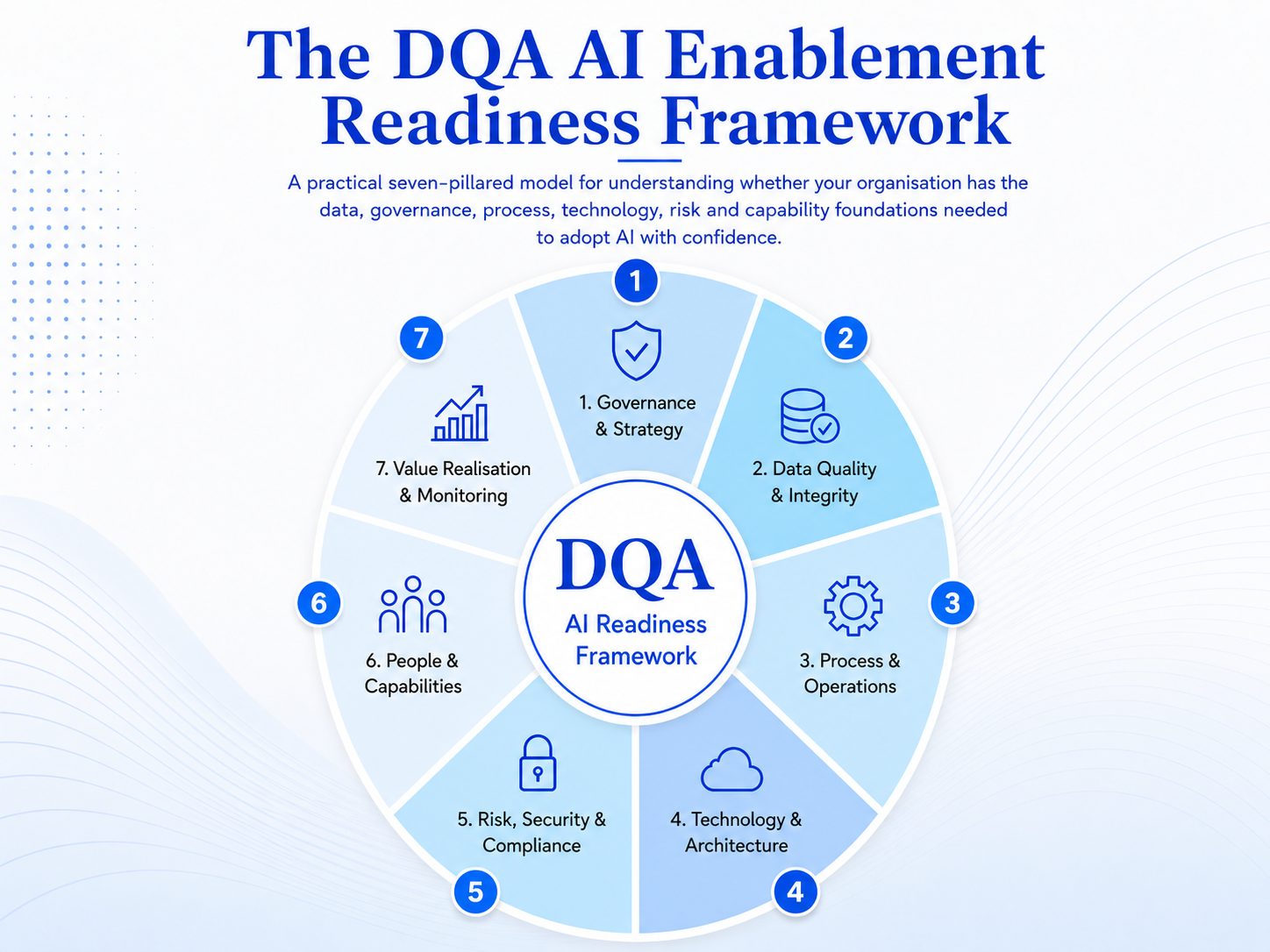
Executive-ready outputs that turn AI ambition into action.
Built for organisations where AI must be trusted, governed, and defensible.
Particularly suited to complex organisations where data quality, governance, accountability, and compliance directly affect decision-making and delivery.
Is your organisation AI ready?
Download the AI Readiness Checklist, a practical self-assessment across the seven foundations that reveal whether your data, ownership, processes, and risk controls can support AI with confidence.

Independent advisory for AI readiness, trusted data, and practical governance.
Led by Rachael Fay, Data Quality Advisory helps organisations prepare for AI, automation, and trusted reporting by strengthening the foundations that determine whether data can be used with confidence, bringing together data quality, governance, information management, reporting confidence, process improvement, and practical AI readiness.
Common questions about AI readiness.
Is this an AI strategy engagement?
No. It is a readiness assessment focused on whether the organisation has the data, governance, process, risk, and capability foundations required to adopt AI safely and effectively.
Do we need to have AI tools selected already?
No. The assessment is often most useful before major AI investment, because it helps identify readiness gaps, risks, and practical opportunities first.
What types of AI initiatives does this support?
Copilot adoption, automation, analytics, reporting improvement, knowledge management, workflow improvement, and broader AI enablement planning.
What if we already know our data quality is poor?
That is often the best time to start. The assessment helps prioritise which data, governance, and process issues matter most.
Is this suitable for government, universities, or regulated organisations?
Yes. The approach is designed for complex organisations where accountability, trust, compliance, and evidence-based decision-making matter.
Book an AI Readiness Discussion.
Explore your organisation's AI ambitions, current data concerns, governance gaps, and practical next steps.